



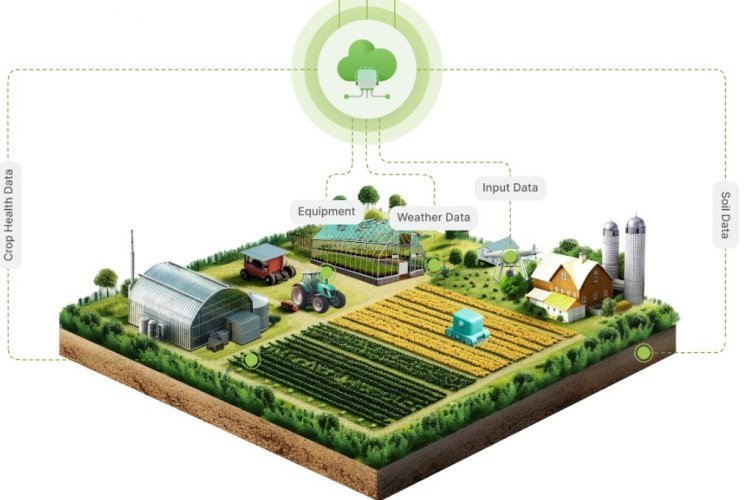
Vinay Nair, Founder of KhetiBuddy, said the company is working towards digitising agricultural data to enhance productivity and ensure better traceability. As part of its global growth strategy, KhetiBuddy is now preparing to enter markets in Europe and Canada. The expansion will be driven by its AI-powered platform, Verdnt, aimed at delivering advanced agricultural data solutions worldwide.
Vinay Nair, founder of the Pune-based agritech firm KhetiBuddy, believes that a major gap persists in the agricultural technology ecosystem: companies offering tech solutions often lack hands-on farming experience, while those with farming expertise are not well-versed in technology. To bridge this divide, he launched KhetiBuddy Agritech Private Limited in 2021.
In a conversation with Rural Voice, Nair said that KhetiBuddy is working to digitize agricultural data at scale. This effort has helped improve farm productivity while bringing down input costs. He added that robust data systems also enable better traceability across the agricultural value chain. However, he acknowledged that adoption of data-driven practices remains a key challenge. To overcome this, the company is actively training farmers. Those who regularly and accurately input data are incentivised with premium payments.
Nair noted that his work in this space began in 2019, although the company was formally established two years later. At present, KhetiBuddy serves around 35 medium and large clients. He is now focusing on expanding the company’s footprint in international markets, particularly in Europe and Canada.

Vinay Nair, Founder, KhetiBuddy
As part of its global expansion strategy, KhetiBuddy has launched a new platform, Verdnt. The platform marks a significant technological upgrade. While the earlier system operated on a SaaS-based model – where data was entered, processed, workflows were created, and reports generated – Verdnt leverages Artificial Intelligence (AI) to streamline and enhance these processes. The company develops its AI capabilities in-house, supported by a dedicated team.
Information on 200,000 Acres of Land Digitized
Khetibadi currently serves around 35 clients, but has successfully digitized data covering nearly 200,000 acres of agricultural land. Explaining the scale, Nair said, “For instance, when we partner with a winery, we digitize all the grape farmers associated with it. Similarly, if we work with a pharmaceutical company, we map all their medicinal plantations. So while our client base may be limited to 30–35, each client accounts for a significantly large acreage.”
Nair highlighted that the company gathers farm data from multiple sources. The primary channel is its mobile application, supplemented by data collected through installed sensors and satellite imagery, including weather-related inputs.
He further noted that the use of farm data varies across sectors. Agri-input companies rely on such data to market fertilizers effectively, while food and beverage firms use it for timely supply chain insights. The government, too, depends on this data for informed policy-making.
Nair also revealed that several agribusiness mobile applications run Khetibadi’s technology in the background, without making it visible to users. According to him, many companies prefer this arrangement to avoid disclosing their technology partnerships to competitors.
Commenting on the government’s “Bharat Vistaar” initiative, Nair said its effectiveness will grow as more data is integrated. “It’s not that data doesn’t exist—it is simply fragmented. The more unified and extensive the data, the more effective the solutions will be,” he added.
Data Solves Traceability Problems
Responding to concerns around traceability and compliance in agricultural exports, Nair said, “We digitize the entire process—from sowing to harvesting. Traceability challenges can be effectively addressed by digitizing the complete value chain, from farm to retail.”
He added that the company provides barcode-based solutions that enable precise tracking of produce. “This system identifies the farmer, the quality of the produce, and even the type of fertilizer used. With access to such detailed farm-level data, we are able to meet diverse compliance requirements of global customers,” he explained.
Challenges in Data Adoption
Speaking about the challenges associated with data, Nair highlighted that data adoption remains the biggest hurdle. “The issue is not so much about technology itself, but about its adoption,” he said.
According to him, most agribusinesses lack confidence in relying on farmers for consistent data entry. As a result, many companies depend on their extension officers, who typically manage data entry for 500–600 farmers.
While data entry at the farmer level is gradually improving, Nair emphasized that it cannot be entirely left to farmers. “To address this, we conduct regular training sessions and identify ‘Champion Farmers’ in each region—individuals who are relatively tech-savvy. They are entrusted with training and guiding other farmers within their villages,” he noted.
He further explained, “On average, a farmer has four to five mobile apps installed. However, even among the most successful applications, only about 15–20% of farmers remain active users, and less than 10% use them on a daily basis.”
Initially, farmers primarily used these apps for basic services such as weather updates and market prices, without exploring their full potential. “To overcome this, we introduced incentives. Farmers who regularly input data are rewarded with benefits, including premium prices for their produce. This approach has significantly encouraged greater participation and learning,” Nair added.
Business Expansion Strategy
In India, the majority of Khetibadi’s customer base is concentrated in the southern states, along with a presence in Maharashtra. The company also serves a limited number of customers in Gujarat and Uttar Pradesh. Khetibadi continues to operate as a bootstrapped venture, having not raised any external funding so far.
Founder Nair noted that expanding into international markets will require investment. “However, it’s not just about capital – we also need partners who can support the scaling of our platform,” he said. He added that venture capital investors often hesitate to invest in the agritech sector, as they typically seek quicker returns. “Ours is not a consumer-driven business, and profitability takes time,” he explained.
Outlining the company’s growth strategy, Nair said, “At present, we have two to three clients in each category. Our immediate focus is to expand this base. At the same time, we are entering global markets, with operations already underway in Canada, the United States, and France.”

