



At the same time, some long-pending proposals, including the much-talked-about air train, are likely to remain on hold for now.
Delhi International Airport Ltd (DIAL) has sought approval from the Bureau of Civil Aviation Security (BCAS) to introduce airside transfers for passengers travelling between Terminal 1 (T1) and Terminal 3 (T3), around eight kilometres apart. The proposal covers domestic-to-international and international-to-domestic transfers.
Clearance from the Directorate General of Civil Aviation (DGCA) is also required, as the buses will cross active taxiways.
While BCAS will examine the proposal from a security standpoint, DGCA will assess aviation safety aspects. Domestic-to-domestic transfer passengers will continue to be transported by buses on the city side between T1 and T3. “DIAL has applied for BCAS clearance for airside transfers between T1 and T3. If approvals come through, airside transfers for domestic-to-international and vice versa could begin by April,” people familiar with the matter said.

DIAL is also evaluating the feasibility of an airside link between T2 and T3, with multiple technical experts studying the proposal, including its impact on the structural integrity of T2. This linkage could become operational by the middle of the year.
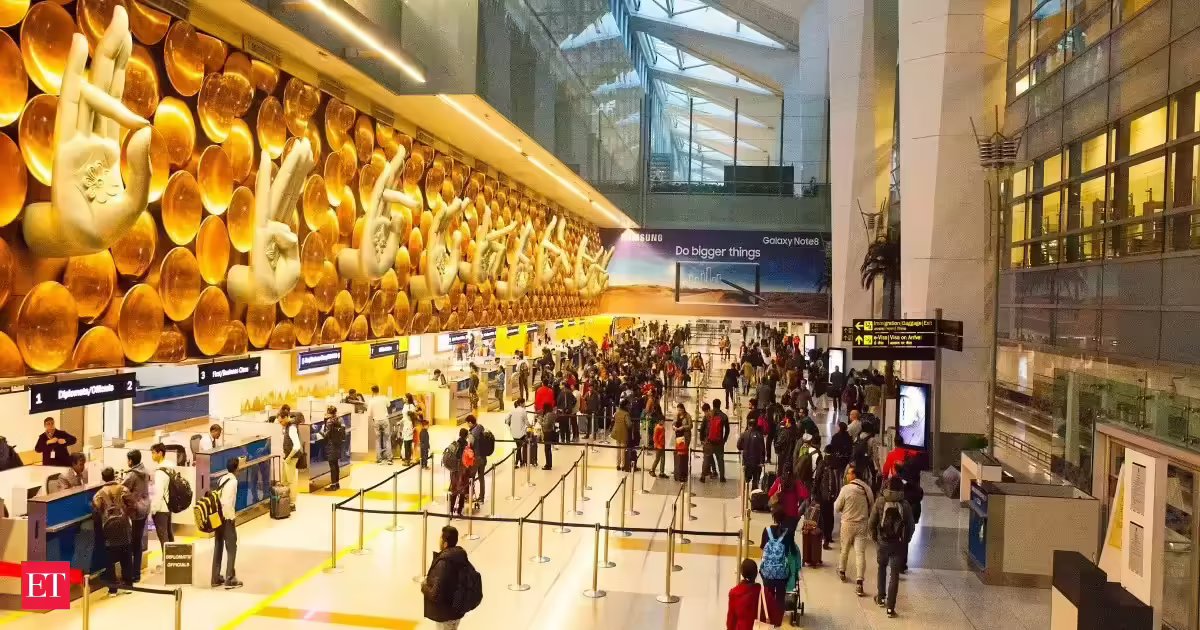
At present, T3 is the only terminal handling international flights, while T1 and T2 are used for domestic operations. Under long-term plans, T1 will continue to serve low-cost domestic carriers, while the proposed Terminal 4—eventually replacing the 1986-era T2—is expected to handle both domestic and international flights. However, the timeline for demolishing T2 and starting work on T4 remains uncertain, with DIAL waiting to assess the impact of the upcoming Noida International Airport on IGIA’s passenger traffic.Pier C to go international
DIAL expects T3’s Pier C to be converted into an all-international pier by March, pending final clearances from BCAS, the Central Industrial Security Force (CISF), immigration and Customs authorities. The airport operator had earlier considered using swing gates to allow Pier C to handle international flights at night and domestic flights during the day, but the idea was dropped due to concerns over mixing of passengers.
Once operational, T3 will have three international piers—A, B and C—while Pier D will handle domestic flights during the summer schedule.
Flyover proposal revived
On the landside, the Public Works Department (PWD) has appointed RITES as a consultant to re-examine the proposal for a Y-shaped flyover between T1 and T3, along with widening of the runway tunnel road to enable signal-free access. The study is expected to be completed by March-April and will be sent to the Centre for consideration under the urban development fund, under which the Centre would bear 80% of the cost and the state the remaining 20%.
The road expansion is seen as necessary in view of the upcoming large commercial and retail developments in Aerocity.
Air train remains stalled
The long-pending proposal for an automated air train linking T1, T2/T3, Aerocity and the cargo terminal remains stalled, with limited chances of implementation in the remaining decade of DIAL’s first 30-year concession period, which ends in 2036. Officials said potential bidders would have too short a window to recover investments, given that construction itself would take three to four years.
DIAL is unable to commit to long-term financial outlays beyond 2036 unless it secures a 30-year extension of the concession period.
In the absence of an air train, the upcoming Golden Line of the Delhi Metro—linking T1 and Aerocity through a 2.3-km underground section—is now being seen as the alternative. With Aerocity already connected to T3 by metro, passengers may eventually transit between T1 and T3 via a platform-to-platform interchange, though officials acknowledge it will not match the seamless experience of dedicated airport people movers seen at hubs such as JFK, Zurich or Dubai.
(With inputs from TOI)

